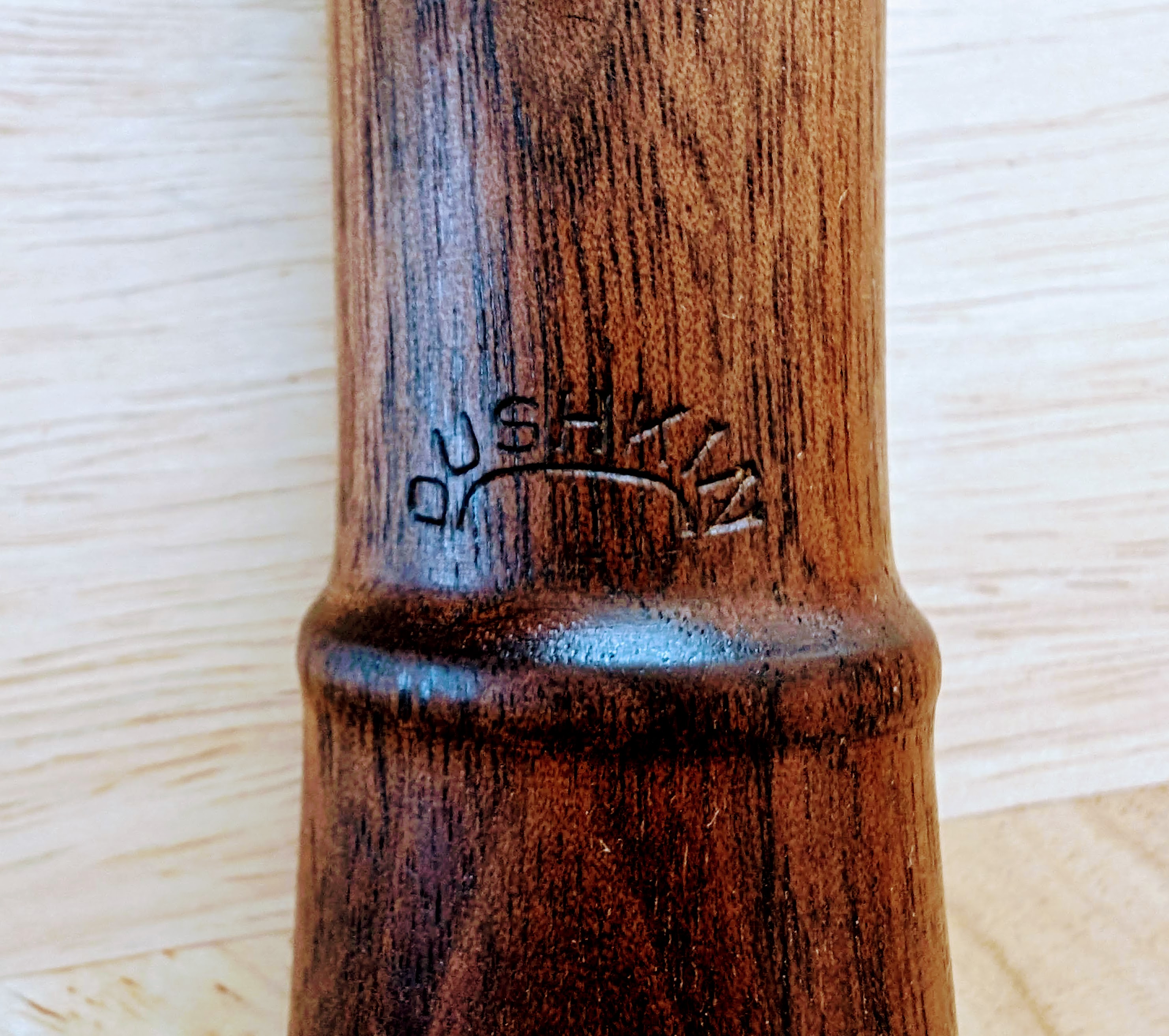
This is the second post I've made about Dushkin recorders.  There's not a lot of information about them on the web.  The first post has info I pieced together from what little I could find.  If you're interested, just look back a few posts.

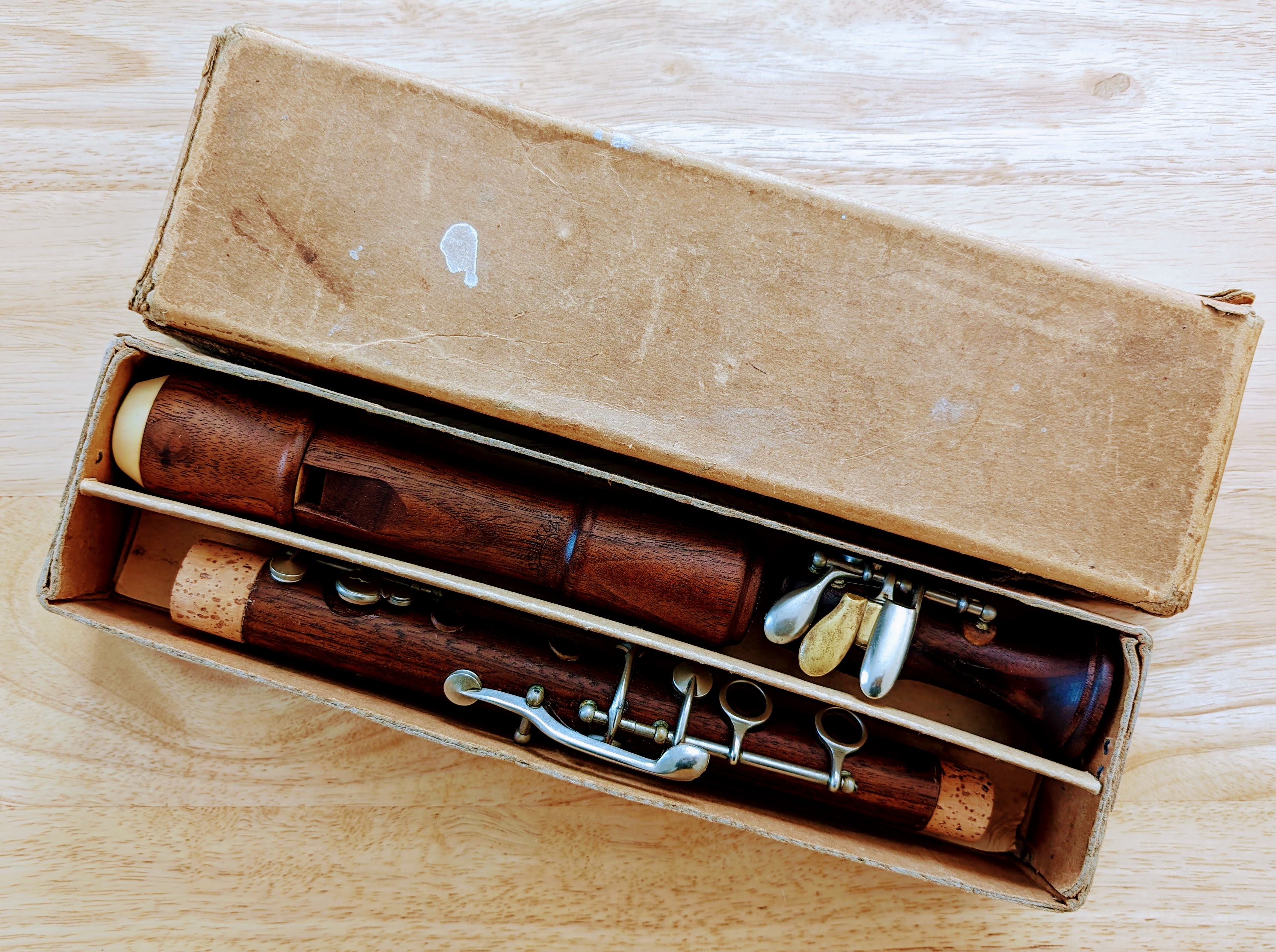
Last summer I was contacted by a woman named Sally who sent me pics of her Dushkin alto recorder, and wanted to know if I could help her learn how to play it.  The pics were small, but it was apparent it was a very unusual recorder.  It had keys, rings and raised toneholes.  Now, there are keyed recorders out there.  I've got a keyed soprano and tenor.  But usually, the keyed recorders are set up like a 6-key piccolo or 8-key flute.  I asked Sally to send some larger, more detailed photos.  She didn't have a musical background.  She had picked up the recorder many years ago somewhere in Ohio because she liked the look of it, and had just rediscovered it in a cabinet and decided to learn how to play it.  I wanted to help her out, but after looking at the pics, I wasn't sure how to do that.  I sent a 6-key piccolo fingering chart her way, but said it was not going to be an exact match and might be a little difficult to figure out.
A few weeks went by, and Sally wrote again that it wasn't working out and wanted to know if I wanted to buy it.  So I sent an offer, and she accepted.  Once it arrived, and I could lay my hands on it, it was even odder than it looked in the photos.  And it needed work, which didn't really help Sally's endeavors.  The pads were shot, the G# key was cracked, there as a broken spring, etc.  So I took it to my repair tech for an overhaul and just got it back.   I'm still trying to figure out the fingerings.  It's kind of a cross between clarinet, oboe, 6-key piccolo and recorder.  The first two octaves play pretty well.  I think the third octave will probably play well too, after I figure out the fingerings (that uppermost key must do something).

I'm thinking this may be some kind of prototype?  I've scoured the net, but I can't find another one like it.  If anyone has an information, or has seen another one, let me know.  And thank you, Sally, for sending it my way.  I'm going to figure this thing out.  🙂


 Brian Blauch - Clarinet/Woodwind Specialist
Hi, my online moniker name is piano-virucide, but you can call me Chet. I wanted to reach out about your post because I had purchased a Dushkin alto at a tag sale earlier this year, and did some research of my own into Dushkin recorders (and still doing to this day casually!). One of the things I had noticed in my initial deep dive was that the alto you posted about in 2021 had a different mouthpiece design than the one I have (this based on pictures of the removable mouthpiece. See pic below, mine on top, yours on the bottom).
I bring this up because I think your newly acquired keyed Dushkin alto might have been manufactured around the same time as mine, based on the way the removable mouthpiece looks (this assuming your keyed Dushkin is not a modified or Frankensteined piece!). I don’t have a verifiable manufacturing date of my alto (though I did find an eBay listing of another Dushkin alto on the internet having the same mouthpiece, and the eBay description says it’s from the 1950s).
I still casually do a deep dive search on Dushkin recorders (and post about it on my Tumblr blog, if you feel like taking a gander at it), but I’ve never came across anything about David Dushkin making keyed recorders. I’m gonna have to keep an eye out for anything about keyed Dushkin recorders the next time I scour my resources, maybe I might find something, maybe not, fingers crossed. 🙂
Hey, Chet here again, I may have found something related.
There’s an article by David Dushkin’s wife, Dorothy Dushkin, titled “Making Musical Instruments in School Shops” (found in either in the Industrial Education Magazine, Volume 40 published 1938 by Manual Arts Press or Manual Training Magazine, Volume 40, published 1938 by University of Chicago Press). From the snippets I could access, the article talks about how the Winnetka students (kids and adults) would have had access to David’s workshop to build instruments and experiment with instrument making, even have group discussions to trade and hash out ideas. A little bit of digging also suggests that instrument-building was a skill that David strongly advocated for musicians to learn (and he even taught courses and wrote a few books on the subject of instrument building in general).
Your keyed Dushkin alto was not in Dorothy’s article, but based on the complexity of the working example instruments listed in the article and how David taught the students in Winnetka, I heavily suspect your keyed Dushkin alto could have been an experimental woodwind by a student or students under David’s guidance. It’s obviously not something I’m unable to confirm, but seems the most likely scenario (especially given that students would most certainly have access to the recorder workshop).
Assuming my educated guess is correct, there may be some dubious nature regarding the overall functionality of the keys (Dorothy has mentioned briefly in her article that there were also failed experiment, though she never gave examples) or maybe your keyed alto prototype was never completed. But I’d like to think that you’ll somehow “crack the code” and figure out what all the keys do. ☺
Hello Chet,
Thanks for the comments. I’ve been super busy lately, but I’ve had a little time to look through your posts. Lots of good information there. :-) After my schedule calms down a bit, I want to go back and delve into your posts some more. In one of your posts you mentioned only finding evidence of one plastic Dushkin online. I picked up a plastic soprano on eBay a couple years ago. I’ll try to get some pics posted at some point.